REVIEW · EVORA
Évora Unforgetable Sidecar Tour
Book on GetYourGuide →Operated by Moma Side My Bike · Bookable on GetYourGuide
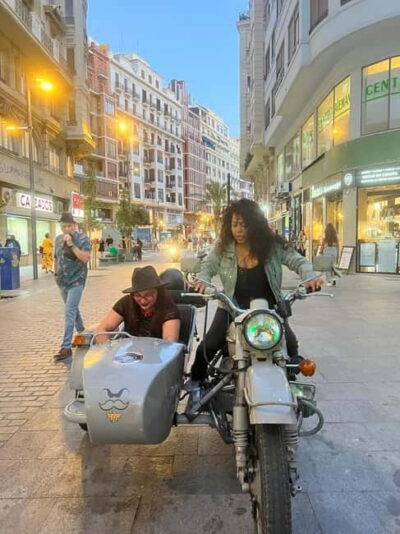
Riding a sidecar makes old Évora feel new, and this 3-hour ride stitches together Celtic, Roman, and Muslim eras without slogging through the whole city. I especially loved Paulo Galego’s way of explaining the story behind each street, tower, and square, and the sidecar ride itself for giving you fast, breezy views plus easy photo stops. You’ll finish with a café-style taste of local life, not just monuments on a checklist.
The main thing to consider is that this is mostly time on the motorcycle sidecar, so you get short stops and a little walking, not long, slow museum meanders on foot.
In This Review
- Key highlights at a glance
- Why Évora looks better from a motorcycle sidecar
- Getting set up: pickups, drops, and Bluetooth helmets
- Alto de São Bento to the first settlers: Eborones and windmill views
- Roman Évora: walls, temples, Sertório, and the big shapes
- From Yeborah to 1166: Visigothic and Muslim legacy near the Cathedral
- Medieval and Manuelino Évora: walls, palace, Giraldo Square, and Portas de Moura
- The old-city walk: cork shops, craft spaces, and what to look for
- The café finish in an early-1900s setting
- Price and value: what $53 gets you in real terms
- Who this tour suits best
- Should you book this Évora sidecar tour
- FAQ
- How long is the Évora Unforgettable Sidecar Tour?
- Is this a private tour?
- Where can I be picked up in Évora?
- Where does the tour end?
- Do we go inside monuments?
- Is there a museum ticket line advantage?
- What languages does the live guide speak?
- What safety equipment is provided for the sidecar ride?
- What is the cancellation rule?
Key highlights at a glance
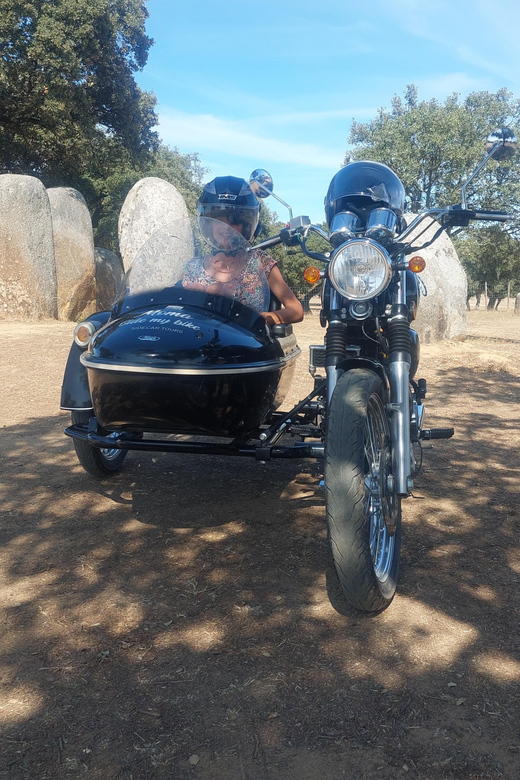
- A quick “eras tour”: Celtic settlers, Roman monuments, Visigothic and Muslim legacy, then medieval and Manuelino Portugal
- Alto de São Bento viewpoint for orientation near the first Eborones settlers
- Helmet helmets + Bluetooth to keep the guide’s English/Spanish/Portuguese narration clear
- Big exteriors, smart pacing: walls, towers, squares, temples, palace-style architecture—mostly from the outside
- Early-1900s café finish with time for talk about local wines and gastronomy, plus peacocks at the end
Why Évora looks better from a motorcycle sidecar
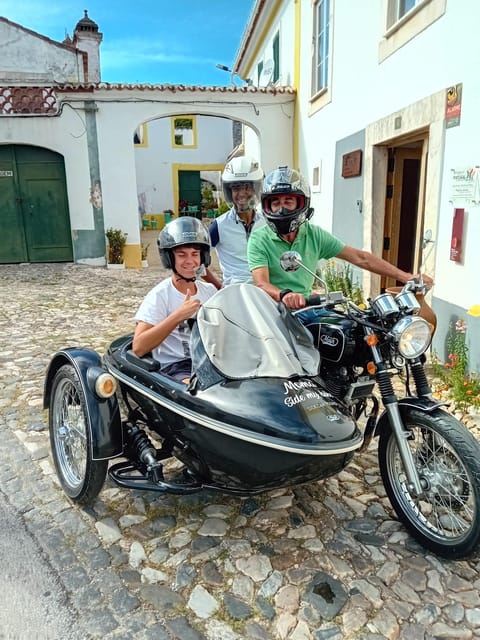
Évora is a place where time stacks up. One street can feel Roman, then medieval, then something that hints at the centuries when different peoples shaped the city’s name and layout. From a sidecar, that mix makes more sense because you’re moving through the city’s geometry, not just standing in one spot.
This tour is built for that “see a lot, understand enough” goal. In about three hours, you cover the key architecture and major heritage areas, with frequent stops for photos and context. You also avoid the problem of doing Évora by bus or taxi: you’ll still end up seeing many monuments, but you won’t get the same story thread connecting them.
And Paulo’s style matters here. He links each era to the city’s physical landmarks—walls, towers, gates, aqueduct lines—so the history feels like it’s mapped onto the streets instead of floating in the air.
Getting set up: pickups, drops, and Bluetooth helmets
You’ll meet the tour at either Capela dos Ossos or Jardim Público, depending on your option. The nice part is that pickup can be arranged anywhere in Évora, and drop-off can be done at your hotel (in the city or outskirts), so you’re not stuck dragging bags across cobbles.
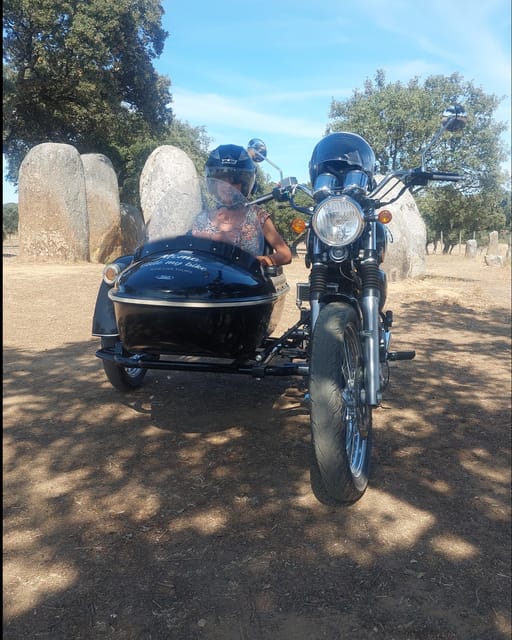
Safety is handled in a straightforward way. There’s a viewpoint moment early on with a safety briefing (about 15 minutes), and you ride with helmets connected by Bluetooth. That means you can still hear the live guide while you’re moving, and it’s less awkward than trying to “guess” what you’re looking at.
The guide speaks English, Spanish, and Portuguese, and the tour is private (so it’s just your group). This matters in a city like Évora, where it helps to ask small questions when you’re standing near something you’ve never seen before.
Alto de São Bento to the first settlers: Eborones and windmill views
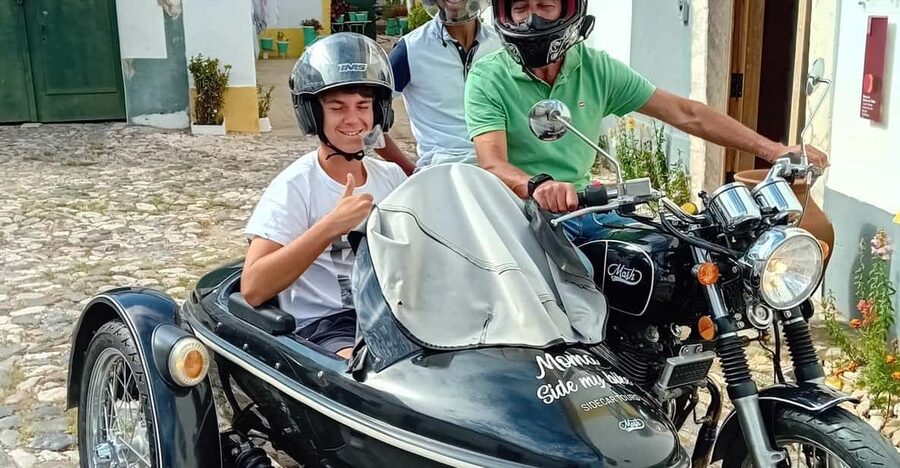
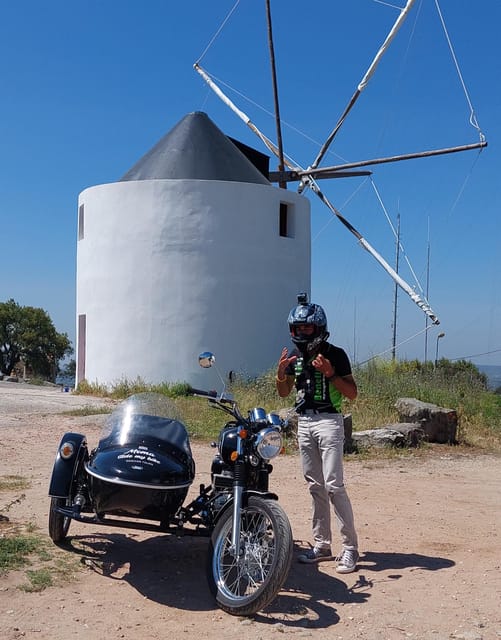
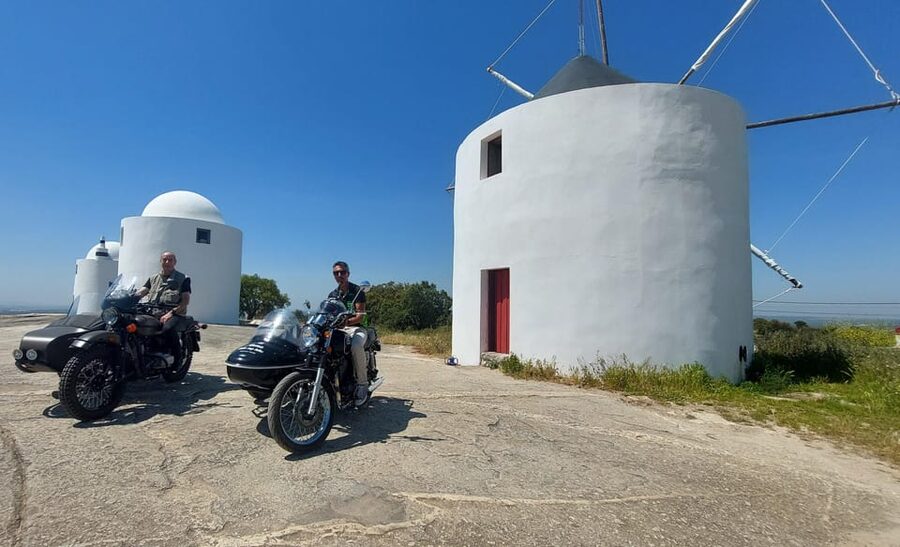
The ride starts near the windmills in Alto de São Bento, which is a smart way to begin. You’re up on a hill first, so you can get bearings fast—where the city sits, how the old walls shape movement, and where the main heritage zones cluster.
From that viewpoint, the story begins with the earliest settlement the tour calls out: the Celtic people, including the Eborones. Even if you’re not a history nerd, the way the guide ties this to the surrounding terrain helps. You start thinking about why people would settle here in the first place: visibility, defensibility, and control of routes.
Then the sidecar drops you down to start the loop through Évora’s major layers. It’s a good pacing trick: you build orientation at the beginning, and then you don’t lose the plot when you’re later weaving through tighter medieval streets.
Roman Évora: walls, temples, Sertório, and the big shapes
Roman Évora is more than a single monument. The tour frames the Roman period as a set of structures and boundaries you can literally see: the ancient battlement walls and the monumental rhythm of towers and civic sites.
As you ride, you’ll pass highlights tied to Roman heritage, including the Roman Temple and Tower Sertório. What I like about this part is that you’re not just “looking at ruins.” You’re seeing how the Roman city’s design creates the skeleton that later periods built around.
Expect a mix of photo stops and short looks as the guide points out what you’re seeing: stone lines, wall shapes, and the way towers sit at strategic points. If you’ve visited other cities with Roman leftovers, you’ll recognize the pattern: Romans often left behind geometry, not just sculptures.
Also, note the tour’s rhythm: it’s not a slow walking archaeology outing. You’ll get the essential context and the key visuals, which is perfect if your goal is to understand the city in one hit.
From Yeborah to 1166: Visigothic and Muslim legacy near the Cathedral
This is where Évora starts to feel like a true crossroads. The tour names the Visigothic and Muslim legacy together as Yeborah, and then it jumps to a specific moment: arriving at 1166 A.C., when the first Foral of Évora was granted.
That kind of date anchor helps. When the guide ties it to visible landmarks—squares, building styles, the placement of monuments—history stops being abstract. You can look at the urban fabric and guess how it might have functioned: markets, passageways, civic authority.
A major stop in this zone is near the 13th-century Cathedral, described as Romanesque-Gothic on the outside. You won’t need to read a guidebook to appreciate it; the exterior style changes are visible enough to make you curious. Nearby, you’ll also pass or see key religious and civic sites the tour highlights, including the Diana Temple, Lóios Monastery, and the Évora Museum area.
Important detail: the tour is mostly about seeing monuments rather than entering lots of buildings. Still, there is a perk if you choose the general sidecar format: free museum entrance for two travellers to the Évora Museum. If that museum matters to you, it’s worth aligning your time with that stop.
Medieval and Manuelino Évora: walls, palace, Giraldo Square, and Portas de Moura
Once you’re in the medieval heart, the tour expands from “what it is” to “how it evolved.” You’ll ride around the medieval walls and towers, plus 17th-century fortifications. That combination is crucial because many visitors only notice the medieval bits or only notice the Roman bits. Here, you see how the city kept reinforcing itself.
Then comes the D. Manuel Palace (15th century), highlighted as representing the Golden Portugal Age and the Manuelino style. Even from outside, that architectural tone tends to look distinctive—more expressive and ornamental compared to plain fortification stones. If you like Portuguese style periods, this stop is one you’ll remember.
After the palace zone, the route continues through major landmarks, including Giraldo Square and Portas de Moura. These aren’t random postcard stops. They’re places where the city’s civic life would have played out, and they help you connect architecture to everyday movement.
Next, you’ll get the aqueduct story—one of the most iconic lines in Évora. The tour includes the Silver Aqueduct and fountains, plus Tower Sisebuto. For me, the aqueduct part is where the tour becomes visually “alive,” because it shows how water infrastructure shaped the city. You’re seeing logistics disguised as architecture.
The old-city walk: cork shops, craft spaces, and what to look for
Even though you’re primarily riding, there’s still a short walk in the old city so you can feel the place at street level. This is where you slow down just enough to notice details you’d miss from a moving seat: shop displays, textures, and the way the streets funnel people between squares.
This tour specifically points you toward locally made products, especially cork goods and crafts. You’ll get time to browse with a bit of guidance on what you’re looking at and why cork matters here. It’s not a hard sell. It’s more like, here’s what this region does, and here’s how it connects to the city’s identity.
If you like souvenir shopping but hate turning it into a time-waster, you’ll probably enjoy this portion. You don’t walk for hours, so you’re not stuck deciding between too many shops. You get enough time to buy one or two things you’ll actually use.
And as you wrap up, Paulo shares practical context about gastronomy and wines, so you can translate the city’s food culture into what to order later.
The café finish in an early-1900s setting
The last act is a café from the beginning of the 20th century. It’s a nice break from walking and staring up at stone. You get a calmer moment, plus space to process what you just saw: Celtic hints up high, Roman structures in the core, and later Portuguese identity expressed through palace style and fortifications.
One small detail that makes the ending memorable: there are peacocks in the garden. It’s the kind of thing you only expect in a place that’s been used as a social stop for a long time, not just a modern tour photo pit.
This finish also helps you leave with a “how to taste Évora” mindset. Even if you’re not booking another meal tour, you’ll have a better idea of what local wines and dishes fit the story you just rode through.
Price and value: what $53 gets you in real terms
At $53 per group up to 1 (so think small-group/private), you’re paying for more than transportation. You’re paying for a guide who links eras to real places, plus a format that covers a lot of ground in a limited time window.
If you’re the type who wants to hit Évora’s highlights quickly, a sidecar tour can feel like excellent value because you’re not trying to plan a complicated route. Also, the tour is designed so you see the major monuments without committing to long interior visits.
Where this price makes sense most:
- You want a fast overview with solid explanations
- You prefer minimal walking
- You like architecture, but you also want the “why” behind it
Where you might reconsider:
- If your main goal is sitting inside multiple museums for long stretches, this format may feel too focused on exteriors and short stops.
- If you strongly prefer driving yourself (instead of riding as a passenger), you may wish it were a different setup.
Who this tour suits best
This experience works especially well for you if:
- You want a guided tour that covers a lot of Évora in three hours
- You’re interested in the city’s layered identity: Celtic, Roman, Muslim/Visigothic legacy, then medieval and Manuelino Portugal
- You like moving through a place while learning it, instead of only standing still
It can be less ideal if:
- You’re chasing long indoor museum time
- You get bored by short stops and prefer one or two monuments explored in depth
Should you book this Évora sidecar tour
I’d book it if you want a smart first look at Évora that balances fun and meaning. The sidecar format helps you see the city’s layout, and Paulo’s guidance is built around connecting what you see to the eras that shaped it. Add the early-1900s café ending and the peacocks, and you’ve got a memory that feels like more than a drive-by.
If you’re the kind of traveller who loves architecture, squares, walls, and aqueduct engineering—and you want a guide to translate it on the spot—this is an easy yes.
FAQ
How long is the Évora Unforgettable Sidecar Tour?
It lasts about 3 hours.
Is this a private tour?
Yes, it’s a private group experience.
Where can I be picked up in Évora?
You’ll have pickup options at Capela dos Ossos or Jardim Público, and pickup can also be arranged anywhere in Évora.
Where does the tour end?
Drop-off can be at Jardim Público or Capela dos Ossos, and you can also be dropped at a hotel in Évora or in the outskirts.
Do we go inside monuments?
The tour focuses on seeing major monuments, mostly from the outside. The Évora Museum can have a free entrance option for two travellers.
Is there a museum ticket line advantage?
The tour includes skipping the ticket line.
What languages does the live guide speak?
The live guide speaks English, Spanish, and Portuguese.
What safety equipment is provided for the sidecar ride?
You ride with helmets that are connected by Bluetooth.
What is the cancellation rule?
You can cancel up to 24 hours in advance for a full refund.